

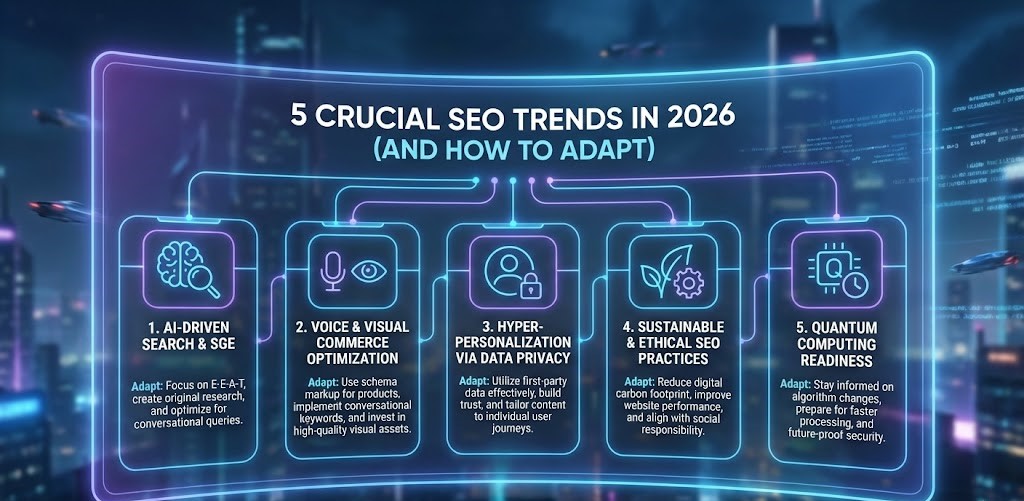
While some SEO fundamentals will always remain important, recent trends have never mattered more. Not because they’re cool hacks, but because they reflect actual, fundamental changes in the way people search and shop online today.
With the rise of Artificial Intelligence and Large Language Models (LLMs) answering queries directly on the search engine results page, the traditional SEO playbook is being rewritten into what industry experts are now calling Generative Engine Optimization (GEO).
In this post, I’ll show you the five SEO trends we’re actively prioritizing in 2026. Each trend comes with clear takeaways you can use to adapt your strategy right away.
1. Third-Party Signals Are an SEO Priority
In the past, the primary third-party focus for SEOs has been link building. Now, links are just part of a much bigger story.
With LLMs relying on a diversity of sources to compose their answers, companies are realizing very quickly that they need to be omnipresent across the web to compete in AI-generated answers. If you ask ChatGPT about invoicing software, it will pull from official sites (like Stripe or QuickBooks) and community-based sites like Reddit or third-party review platforms.
How this changes your strategy: You need to perform prompt research to see where LLMs are pulling their information from when answering relevant queries. Then, develop a digital PR and outreach plan for getting featured or mentioned on those exact third-party sites.
2. Top-of-the-Funnel Content is Measured Differently
Top-of-the-funnel content (also called “awareness content”) used to be excellent for driving massive traffic to a site because the topics appealed to a wide audience. However, Google’s AI Overviews now answer a lot of those basic queries right at the top of the search results, making it unnecessary for searchers to click on a website.
Does this mean top-of-the-funnel content isn’t worth it? Not at all. It just has a new job. Stories that are widely relevant (like data studies or industry surveys) are highly appealing to top publishers, making them incredible vehicles for earning third-party authority signals and LLM citations.
How this changes your strategy: Don’t think about top-of-the-funnel content purely in terms of search volume; think of it in terms of newsworthiness. Create high-level content that is highly relevant, timely, or impactful enough that other sites will cite it.
3. Niche Content Is Worth the Investment
If top-of-the-funnel content is getting a new job, niche content is becoming the absolute star of the show.
LLM prompts rarely look like classic, short head terms anymore. Instead of searching “best invoicing software,” users are prompting: “simple invoicing tool for a solo graphic designer in Virginia who gets paid in EUR and USD.”
To build an answer that feels custom to the user, the AI model needs detailed pages written for clear, specific use cases. There’s so much generic content on the web that broad advice has become invisible. What stands out now is content that feels like, “This was written for someone exactly like me.”
How this changes your strategy: Treat niche content as your way to “own” specific situations, not just keywords. Map out your top industries, use cases, and edge cases, then create content that speaks directly to those scenarios—even if the traditional search volume looks tiny.
4. Intent-Driven Strategy is Now Persona-Driven Strategy
For years, most SEO strategies were built around search intent labels: informational, commercial, transactional, navigational. Now that AI search tailors results to the person behind the query, those labels are not enough.
Two people can ask nearly the same question and get wildly different answers based on their context, past behavior, and phrasing. For example, if an SEO expert asks ChatGPT for course recommendations while logged in, the AI will evaluate their past prompts and recommend advanced, high-level courses (like those from Reforge). If a beginner asks the exact same question, they get a totally different, generic list.
How this changes your strategy: Keep using intent, but treat it as a supporting detail. Start with 3–5 clear buyer personas. List their real problems and workflows, then map search topics, prompts, and content ideas directly to those people.
5. Traffic KPIs are Replaced by Visibility KPIs
Even though traffic used to be the most important marketing metric, it only ever showed one part of the picture. The truth is: you can influence a lot of buying decisions without ever getting the click.
AI Overviews, rich snippets, comparison carousels, Reddit threads, and LLM answers all shape what people think of you before they ever touch your site. If you’re only measuring who arrives via Google Analytics, you are missing where the action happens. Visibility and Share of Voice are becoming the new north stars.
How this changes your strategy: Shift your KPIs. You need to know how often your brand shows up when people ask questions online, where you appear compared to competitors, and whether those mentions are positive or negative. That visibility still moves your sales pipeline, even if the click path is messy!

Conclusion: Winning SEO in 2026
The SEO landscape of 2026 might feel like a radical departure from the past, but at its core, it’s simply evolving to match human behavior. The rise of Generative Engine Optimization (GEO) and AI Overviews doesn’t mean traditional SEO is dead—it means the playbook has matured. We are moving away from chasing empty traffic metrics and moving toward building genuine brand authority, deep topical expertise, and holistic digital visibility.
To stay ahead of the curve, keep these five shifts at the center of your strategy:
- Earn the Citation, Not Just the Link: Focus on digital PR and getting your brand mentioned on authoritative third-party platforms and communities.
- Rethink Top-of-Funnel ROI: Create high-level awareness content for its newsworthiness and shareability to feed LLM algorithms, rather than just looking at raw search volume.
- Double Down on Niche Topics: Write highly specific content that directly answers the complex, highly detailed prompts users are feeding into AI search engines.
- Optimize for the Persona: Move beyond basic search intent labels and build content around the real-world problems, nuances, and workflows of your specific target audience.
- Measure What Actually Matters: Shift your executive reporting from raw organic sessions to AI visibility, entity mentions, and total Share of Voice (SOV).
Also Read : What are the types of SEO? You Need to Know for 2025