

Proving the value of your SEO efforts to stakeholders can feel like an uphill battle. What is the cheat code to getting executive buy-in? Tracking the right SEO Key Performance Indicators (KPIs)—not just the default vanity metrics sitting in your dashboard.
Here is the truth: Just because you can measure a bunch of different metrics doesn’t mean you should treat them all as KPIs.
- SEO Metrics are broad data points (e.g., bounce rate, total organic traffic).
- SEO KPIs are metrics directly tied to concrete business outcomes (e.g., demo signups from organic traffic, revenue generated).
Here is your complete guide to choosing and monitoring the SEO KPIs that actually mean something for your business’s bottom line in 2026.

1. Conversion and Revenue KPIs
No matter what stage of SEO investment you are in, you should track conversion and revenue-related KPIs. These metrics prove your work is driving actual business growth.
| KPI | What It Measures | How to Track It |
| Organic-Assisted Conversions | How often organic search influenced a purchase, even if it wasn’t the final touchpoint. | GA4 Attribution Paths Report |
| Demo / Trial Signups | Leads directly generated from organic search traffic. | GA4 Event Tracking with source segmentation |
| Form Opt-Ins | Mid-funnel conversions like email newsletter signups or contact forms. | Form analytics tools or GA4 Events |
| Organic Revenue | Earned revenue directly attributed to organic search visitors. | E-commerce tracking in GA4 or CRM integrations (like Salesforce) |
2. Visibility and Awareness KPIs
Because of the rapid rise of AI search tools, visibility KPIs are no longer just for massive brands—they are essential for everyone. Being included in AI-generated answers is becoming just as crucial as ranking #1 on a traditional search page.
| KPI | What It Measures | How to Track It |
| Organic Impressions | The number of times your site appears in search results. | Google Search Console (GSC) |
| Branded Search | How often users search for your specific brand name. | GSC or Semrush Domain Overview |
| SERP Feature Ownership | Your presence in Featured Snippets, Knowledge Panels, and “People Also Ask” boxes. | Semrush Position Tracking |
3. Engagement and Behavior KPIs
Once you have steady traffic, you need to know if users actually care about your content. Engagement KPIs help you uncover UX blockers and content gaps.
| KPI | What It Measures | How to Track It |
| Click-Through Rate (CTR) | The percentage of impressions that result in actual clicks. | Google Search Console |
| Engaged Sessions | How far users scroll and interact with your page. | GA4 Engaged Sessions metric |
| Pages per Session | The average number of pages a user views before leaving. | GA4 Views per Session |
| On-Page “Hot Spots” | Visual maps of where users click and focus their attention. | Heatmap tools like Hotjar or VWO |
4. Authority and Ranking Power KPIs
If you are actively investing in digital PR and content clusters, you need to track your topical authority and share of voice against your competitors.
| KPI | What It Measures | How to Track It |
| Referring Domains (Backlinks) | The number of unique external websites linking back to your site. | Semrush Backlink Analytics |
| Ranking Content Percentage | The portion of your total indexed content that ranks in the top 3 positions. | SERP tracking tools |
| Share of Voice (SOV) | Your total search visibility compared to competitors for core topic areas. | Semrush Position Tracking |
5. Emerging KPIs for the AI Search Era
The SEO landscape has shifted dramatically with the introduction of Large Language Models (LLMs). To survive in 2026, you need to monitor your visibility inside AI tools.
- LLM Mentions: The frequency of your brand/product being mentioned in outputs from tools like ChatGPT or Perplexity.
- AIO Visibility Rate: Your presence inside Google’s AI Overviews (AIO).
- LLM-Driven Traffic: Visitors arriving at your site via citations in AI search channels. (Tracked via GA4 source identification and UTM parameters).
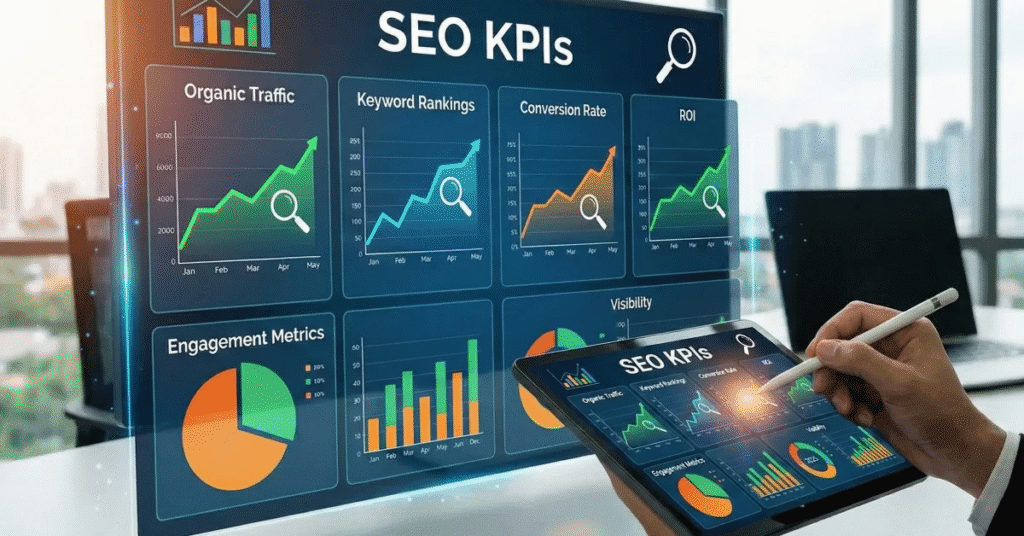
How to Choose the Right KPIs for Your Business
There is no one-size-fits-all SEO KPI list. To choose the right metrics for your team, follow these four steps:
- Align with Your Business Model: A local plumber should track Map Pack visibility and phone call clicks. A global B2B SaaS company should track demo signups and branded search growth.
- Map the Audience Journey: Does your audience do heavy research across multiple platforms before buying? Track impressions and engagement. Are they high-intent, immediate buyers? Focus heavily on CTR and conversion metrics.
- Define Strategic Outcomes: Categorize your goals into four buckets: Brand Visibility, Lead Generation, Revenue Impact, and Authority Building. Pick one KPI for each.
- Match Your SEO Maturity: If your site is brand new, track content production and impressions. If your site is established, track revenue impact and share of voice.
Also Read : Beyond Keywords: A Modern Approach to On-Page SEO