
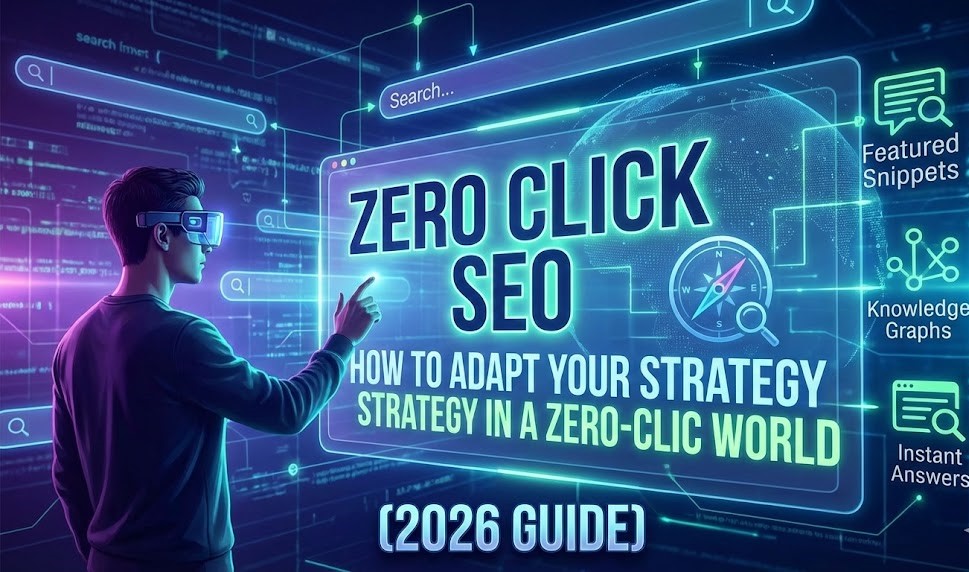
The way people search has fundamentally changed at its core. Today, the majority of users get complete answers directly on Google without ever clicking through to a website. Featured snippets, AI Overviews, Knowledge Panels, and instant answer boxes now resolve queries right on the search results page (SERP).
If your website traffic is dropping even though your rankings remain perfectly stable, you are likely losing out to zero-click searches.
Here is your candid, expert-backed guide to understanding exactly why this shift is happening and how to adapt your SEO strategy to dominate a visibility-first world.
What Is a Zero-Click Search and Why Does It Happen?
A zero-click search occurs when a search engine uses AI to extract vital information from web content and displays the complete answer directly on the results page.
According to global data from Statista, mobile devices generate over 60% of web traffic. Yet, mobile users are the least likely to click organic results, preferring instant answers right on their screens. This shift is happening because:
- Speed: Faster information delivery drastically improves the user experience.
- Voice Search: Conversational search interfaces require immediate, spoken responses rather than a list of blue links.
- Semantic AI: Search systems now interpret the meaning and context of a query, rather than just matching keywords.
When search engines select content for these instant answers, they prioritize clarity, structure, and reliability.
Traditional SEO vs. Zero-Click SEO
This zero-click environment changes how businesses grow. Traffic alone is no longer the sole indicator of success. SEO has moved from competing for page clicks to competing for knowledge ownership.
| Focus Area | Traditional SEO | Zero-Click SEO |
| Main Goal | Website traffic | Search visibility & brand authority |
| Success Measure | Click-through rate (CTR) | SERP impressions & brand citations |
| Content Format | Ranking-focused, long-form pages | Extractable, concise answers |
| User Journey | Click, read, and convert | See answer, trust brand, search brand |
| Optimization Target | Specific Keywords | Semantic structure & entity connections |
6 Strategies to Adapt to a Zero-Click World
To survive and thrive in a zero-click environment, you must structure your content for AI extraction while simultaneously building undeniable topical authority.
1. Target Position Zero
Structure your content so that it answers questions directly and efficiently. Use a question-based heading (H2) and immediately follow it with a short answer of 40 to 60 words. Google’s Search Central guidelines show that clear answers formatted with bulleted lists and numbered steps are highly favored for featured snippets.
2. Implement Structured Data
Structured data acts as a direct translator for search systems, helping them understand your content’s meaning. Implementing official Schema.org markup—such as FAQ, Article, How-to, or Local Business schema—explicitly tells AI systems what your page is about, drastically increasing your chances of being featured.
3. Increase Local Visibility
Local searches (“near me”) almost always result in zero-click answers via map packs. To dominate this space, ensure your Name, Address, and Phone number (NAP) are strictly consistent across the web, and fully optimize your Google Business Profile.
4. Build Authority Content Clusters
Search engines only cite sources they trust. Build authority by creating detailed pillar guides, using logical internal linking, and backing up your claims with evidence. When users see your brand repeatedly cited for complex topics, trust naturally grows—even if they don’t click on your website.
5. Optimize for AI Citation
To increase the likelihood that Large Language Models (LLMs) will cite your brand, you must format your writing logically. Provide a short definition before diving into detailed explanations, keep your terminology consistent, and avoid fluffy, unnecessary introductions.
6. Target High-Intent Queries
Broad informational queries (“What is SEO?”) trigger zero-click answers. Deep, complex queries encourage actual website clicks. Shift your keyword strategy to target clear, purpose-driven questions that require deep context and nuance that a quick AI summary cannot provide.
How to Measure ROI from Zero-Click Searches
Because clicks are no longer guaranteed, you need new performance indicators to measure your success. Instead of obsessing over Google Analytics traffic, track these metrics:
- Growth in Branded Search: Are more people searching for your company name after seeing your featured snippets?
- SERP Impressions: How often is your content being seen on the results page?
- Featured Snippet Ownership: Use tracking tools like Semrush to monitor exactly how many zero-click features your brand owns.
- Quality of Conversions: Are the visitors who do click through converting at a higher rate because you’ve already established trust?
The Future of Search
AI-driven discovery and answer-first experiences are the future. Modern SEO is about ensuring your information is available wherever people look for answers. Brands that prioritize extractable, highly structured, and authoritative content will lead the next generation of search and become the most trusted names in their industries.
Also Read : Image SEO: 15 Essential Optimization Tips for 2026