

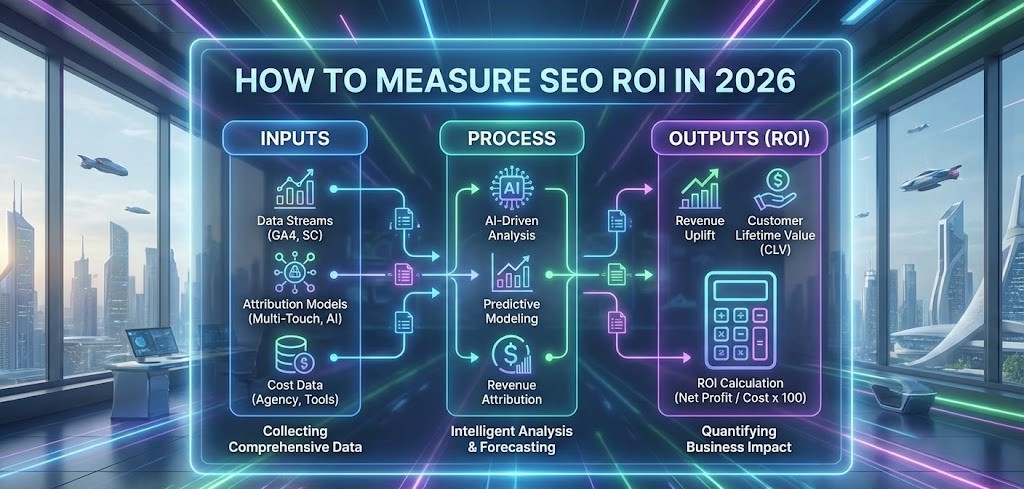
In 2026, measuring SEO ROI requires completely new strategies. The digital landscape features complex AI ecosystems and personalized results. Therefore, vanity metrics like raw traffic volume no longer work. You must align technical search performance directly with actual revenue.
Around 49% of marketers consider organic search their highest ROI channel. Furthermore, organic search drives roughly 40% of total business revenue.

Establishing the Best Measurement Methods
To understand your digital marketing health, you must track actual capital movement. Effective ROI measurement requires direct attribution and long-term asset valuation.
The standard ROI formula remains your foundational tool. You subtract your investment cost from your organic revenue. Then, you divide that number by your total investment cost.
However, tracking exact organic revenue presents massive challenges today. Users might discover your brand through an AI overview initially. Weeks later, they might convert through a direct branded search. Therefore, you must implement multi-touch attribution (MTA). MTA gives your SEO efforts the correct percentage of credit.
The Lifecycle of SEO Costs
You must look beyond simple monthly agency retainers. You must accurately calculate your total organic search investment to find your true ROI.
- Human Capital: Track all internal hours spent on strategy and approval.
- Production Costs: Calculate expenses for high-fidelity videos and original research.
- Technical Infrastructure: Include premium hosting and essential SEO software subscriptions.
Tracking in the AI Era
Traditional click-through rates no longer dictate complete search success. Forward-thinking brands now optimize for Large Language Model (LLM) citations.
Experts use a new metric called “Share of Model.” This measures how frequently AI assistants recommend your specific brand. You must build your tracking framework around three fundamental concepts.
- Path Analysis: Discover how many organic touchpoints drive a final sale.
- Brand Lift Metric: Track increases in direct branded search volume over time.
- Media Value Equivalence: Calculate the exact PPC advertising cost of your organic traffic.
Comparing ROI Measurement Models
Agencies generally use two primary analytical approaches for measurement.
- The Lead Attribution Model: This serves as the B2B industry benchmark. You must link your analytics directly to your CRM system. This tracks a specific visitor from initial search to final contract.
- The Market Share Model: E-commerce businesses frequently use this specific approach. Agencies measure your total digital share of voice. They project ROI based on your average conversion rate and order value.
Practical Steps to Measure ROI Today
Start building your data foundation with a technical SEO audit. Clean, first-party data prevents flawed and undervalued ROI calculations.
- Establish Value Per Lead: Calculate the exact financial worth of a new prospect.
- Audit Attribution Windows: Set your tracking window to at least 90 days.
- Calculate the PPC Gap: Determine your saved ad spend from high-ranking keywords.
- Account for Longevity: Distribute content costs over their entire productive lifespan.
Stop making assumptions about your marketing expenses today. Build a transparent, real-time revenue dashboard to prove your organic search value!
Also Read : What are the types of SEO? You Need to Know for 2025