

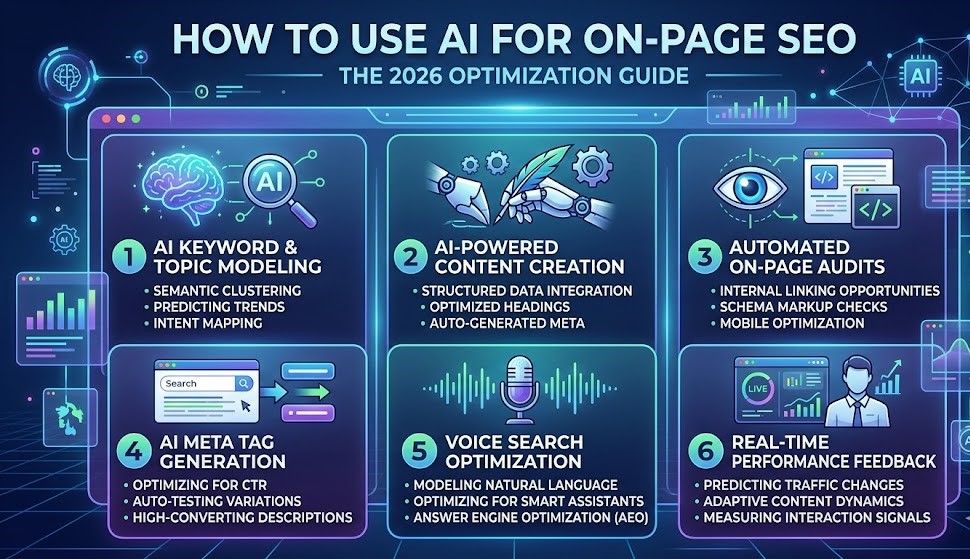
The era of manual meta-tag tweaking and spreadsheet-heavy keyword research is over. In 2026, AI has transformed on-page SEO from a time-consuming chore into a high-speed, data-driven science. By utilizing machine learning, businesses can now analyze thousands of data points instantly to identify the exact “intent” Google’s algorithms are rewarding.
With the AI SEO tool market projected to reach $1.5 billion by 2030, mastering these tools is no longer optional—it is a competitive necessity.

At a Glance: AI’s Impact on SEO Elements
| SEO Element | How AI Transforms It |
| Keywords | Identifies “hidden” high-intent, long-tail opportunities. |
| Content | Scores readability and suggests semantic (LSI) terms. |
| Meta Tags | Generates click-worthy titles based on emotional triggers. |
| FAQ Pages | Optimizes for AI Overviews with concise, 40-60 word answers. |
| Internal Links | Maps site architecture to distribute authority automatically. |
5 Practical Ways to Implement AI On-Page SEO
1. Content Creation & Semantic Depth
AI writing assistants like Jasper and Surfer SEO do more than write text; they analyze the top 10 ranking pages to build a “content score.”
- The Strategy: Use AI to identify “content gaps”—topics your competitors missed—and integrate Natural Language Processing (NLP) keywords to ensure search engines recognize your topical authority.
2. Intelligent Keyword Grouping
AI tools now group keywords by user intent (informational vs. transactional) rather than just volume.
- The Strategy: Use Frase.io to cluster keywords into “topic silos,” ensuring your site structure aligns with the buyer’s journey.
3. Optimizing for “AI Overviews”
Google’s AI-generated summaries prioritize directness. To appear in these coveted spots:
- The Strategy: Structure your FAQs with question-based H2/H3 headers. Provide a direct answer in the first line (approx. 50 words) followed by supporting facts or figures to boost trust.
4. Technical Performance & Image SEO
AI-powered technical audits find resource-heavy elements that slow down your site.
- The Strategy: Use AI to generate keyword-rich Alt Text for images, making your site more accessible and improving your visibility in visual search results.
5. Automated Internal Linking
Internal linking is critical for distributing “link juice.”
- The Strategy: Tools like Rank Math offer one-click internal link suggestions based on the semantic relationship between your blog posts and service pages.

Top AI Tools for On-Page SEO in 2026
| Tool | Best For | Key Feature |
| Surfer SEO | Content Scoring | Real-time NLP keyword suggestions. |
| Clearscope | Content Authority | Semantic topic modeling for competitive niches. |
| Jasper AI | Efficiency | High-speed, SEO-optimized draft generation. |
| Frase.io | FAQ/Snippet Optimization | Analyzes real user questions for direct-answer ranking. |
Case Study: 156% Organic Traffic Increase
A B2B SaaS client used a multi-tool AI approach to move from position 18 to position 4 in just 90 days.
- Step 1: Used Frase to find long-tail variations like “remote team tools.”
- Step 2: Optimized content word count and headers using Surfer SEO.
- Step 3: Implemented FAQ Schema with Rank Math to capture featured snippets.
Also Read : Long-Tail Keyword Optimization for AI