

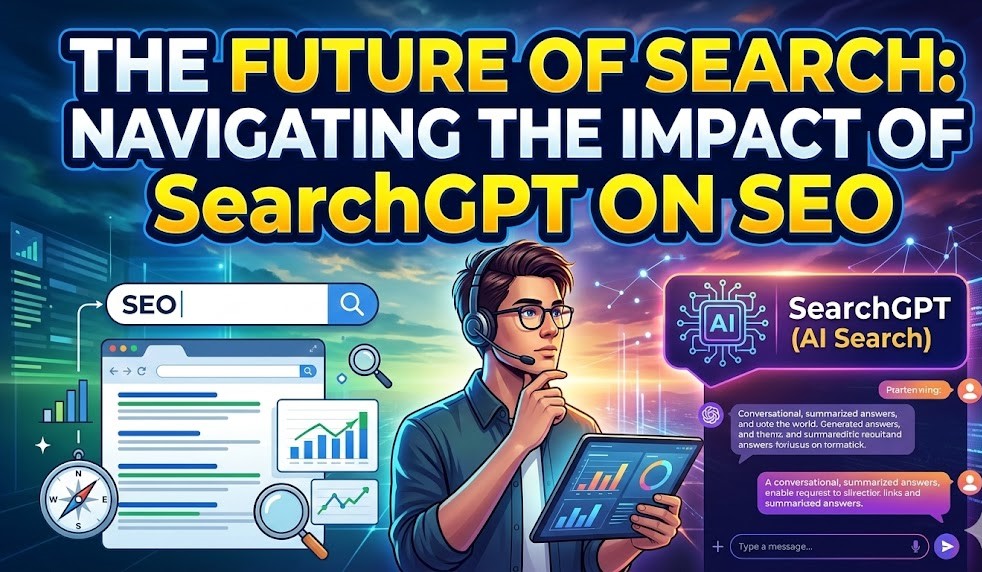
As we move through 2026, the digital landscape has shifted from a “library of links” to a “conversation of answers.” The integration of SearchGPT (now a core part of ChatGPT Search) has fundamentally altered how users discover information. Unlike traditional search engines that present a list of websites, SearchGPT synthesizes real-time data into a cohesive, conversational response. According to recent industry data from Search Engine Land, nearly 60% of AI-driven queries now result in “zero-click” searches, where the user finds their answer without ever leaving the AI interface. This doesn’t mean SEO is dead, but it has evolved into GEO (Generative Engine Optimization), where the goal is to become the primary cited source within the AI’s response.
🔄 The Shift from Rankings to Citations
In the traditional Google era, the “Top 3” spots were the holy grail. In the SearchGPT era, the focus has shifted to Citation Share. When SearchGPT generates an answer, it pulls from a select few high-authority sources and provides clickable citations. To stay visible, businesses must focus on AEO (Answer Engine Optimization), a technique that structures content specifically for machine readability. Technical resources from Ahrefs suggest that content following a “Claim-Evidence-Conclusion” structure is 40% more likely to be picked up by Large Language Models (LLMs) than traditional long-form narrative blogs. By placing the “answer” at the very beginning of a section, you make it easier for the AI to “lift” your data into its summary.
🛠️ Technical Requirements for the AI Era
To ensure your brand is “AI-ready,” technical SEO has become more rigid. Schema Markup (JSON-LD) is no longer optional; it is the “nutrition label” that tells SearchGPT exactly what your data represents. Whether it is Product, FAQPage, or Organization schema, these tags help the OpenAI SearchBot verify your site’s entities and their relationships. Furthermore, internal linking has taken on a new role. Instead of just passing “link juice,” internal links now help AI models map out your Topical Authority. If your site is interconnected with clear, descriptive anchor text, SearchGPT is more likely to view your domain as a comprehensive expert on a specific subject, increasing your chances of being the “featured” answer.
📈 The “Information Gain” Factor
SearchGPT’s algorithms are increasingly adept at filtering out “AI-regurgitated” content. To compete in 2026, your content must provide Information Gain—new, proprietary data or unique perspectives that don’t exist elsewhere on the web. This might include original case studies, unique survey results, or expert interviews. Insights from Semrush indicate that pages with unique data visualizations or first-hand “Experience, Expertise, Authoritativeness, and Trustworthiness” (E-E-A-T) are prioritized by generative engines. This means that “SEO writing” must shift away from repeating common keywords and toward providing high-value, citable facts that an AI can’t ignore.

💡 Conclusion: Adapting to the Conversational Web
The impact of SearchGPT on SEO is a transition from a competitive “popularity contest” to a rigorous “authority contest.” While the total volume of organic clicks may decrease due to AI summaries, the quality of traffic originating from AI citations is significantly higher. Users who click through from a SearchGPT citation are often further down the sales funnel, having already been educated by the AI’s summary. By prioritizing structured data, topical depth, and original insights, you ensure that your brand isn’t just a link in a list, but a trusted voice in the global conversation.
Also Read : What are the types of SEO? You Need to Know for 2025