

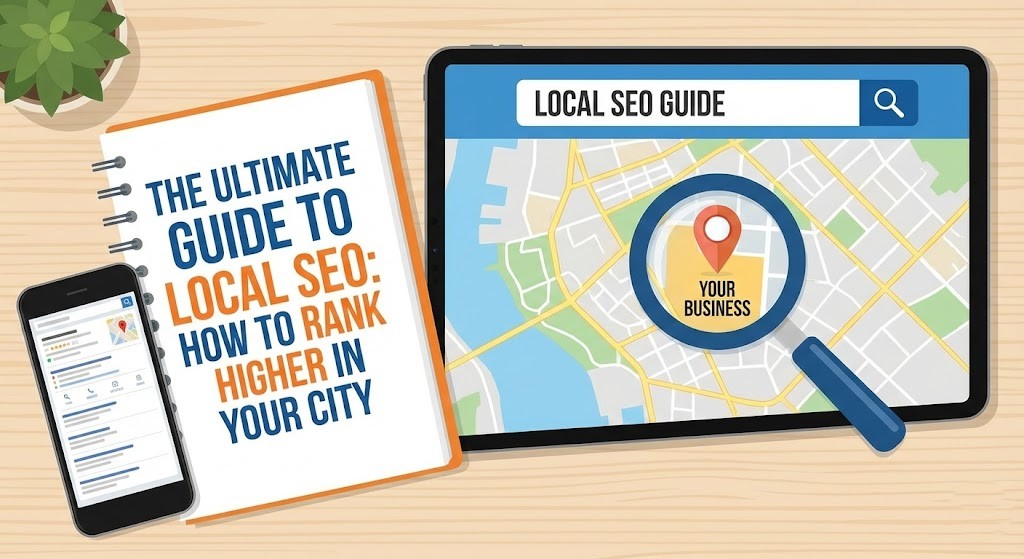
If you own a physical store, a restaurant, or a local service business (like plumbing or tutoring), ranking globally on Google isn’t your priority—ranking locally is.
Local SEO is the process of optimizing your online presence to increase visibility in local search results. It is the strategy that helps your Google Business Profile appear in the coveted “Local Pack” (the map listing at the top of search results) when customers search for “Mexican restaurants near me” or “dentist in [City Name].”
Unlike traditional SEO, which focuses on global reach and blogging, Local SEO focuses on specific geographic signals. Here is how to master it.

How Local SEO Works
Google uses a different set of criteria to rank local results compared to standard web pages. According to Google, the three main pillars are:
- Relevance: How well does your business match what the user is searching for?
- Distance: How far is the potential customer from your location?
- Prominence: How well-known and trustworthy is your business? (Based on reviews, links, and citations).
To succeed, you need to prove to search engines that you are relevant, nearby, and reputable.
Step 1: Master Local Keyword Research
You cannot rank if you don’t know what your customers are typing into the search bar.
- Identify Core Terms: Start with the basics (e.g., “plumber,” “coffee shop”).
- Use Modifiers: Add location-based modifiers. For example, use Google Autocomplete by typing “best pizza in…” to see what cities or neighborhoods pop up.
- Analyze Competitors: Tools like Semrush’s Keyword Gap allow you to compare your site against local competitors to see which “untapped” keywords they rank for that you don’t.
Step 2: Optimize Your Google Business Profile (GBP)

Your Google Business Profile is the heart of your local SEO strategy. An incomplete profile is a wasted opportunity.
- Complete Every Field: Ensure your hours, address, and contact info are accurate.
- Add Media: Upload high-quality photos of your storefront, team, and products.
- Stay Active: Use the “Updates” feature to post about events, offers, or news. An active profile signals to Google that you are still in business and engaged.
Step 3: Manage Your Citations (NAP)
Citations are online mentions of your business’s NAP (Name, Address, Phone number). These usually appear in directories like Yelp, Bing Places, and Yellow Pages.
Consistency is key. If your address is “123 Main St.” on Google but “123 Main Street Suite A” on Yelp, it confuses search engines and hurts your trust score.
- Audit Your Listings: Use tools to check for duplicate or inconsistent listings.
- Distribute Data: Ensure your correct NAP is submitted to major data aggregators.
Step 4: Generate and Respond to Reviews
Reviews are a major ranking factor for “Prominence.” They provide social proof to both Google and potential customers.
- Ask for Feedback: Don’t be afraid to ask satisfied customers to leave a review. (Note: Never buy reviews or offer money for them—this violates Google’s policies).
- Respond to Everyone: Reply to both positive and negative reviews. This shows you value customer feedback and are an active business owner.
Step 5: Localize Your On-Page SEO
Your website needs to speak the local language, too.
- Title Tags & Meta Descriptions: Include your city and service in your page titles (e.g., “Best Auto Repair in Dallas, TX”).
- Location Pages: If you serve multiple cities, create a unique landing page for each location rather than stuffing all city names onto your homepage.
Step 6: Monitor Your Results
Local rankings can fluctuate based on exactly where the user is standing. To get an accurate picture, you need to track more than just a single number.
- Map Tracking: Use tools like a Map Rank Tracker to see how you rank in specific neighborhoods or radiuses around your business.
- Google Search Console: Use Google Search Console to monitor which local queries are driving clicks to your site.
Conclusion
Local SEO is not a “set it and forget it” task. It requires consistent effort in managing your reputation, keeping your business information accurate, and adapting to how your neighbors search. By following these steps, you can turn local searches into foot traffic and loyal customers.
Also Read : What are the types of SEO? You Need to Know for 2025