

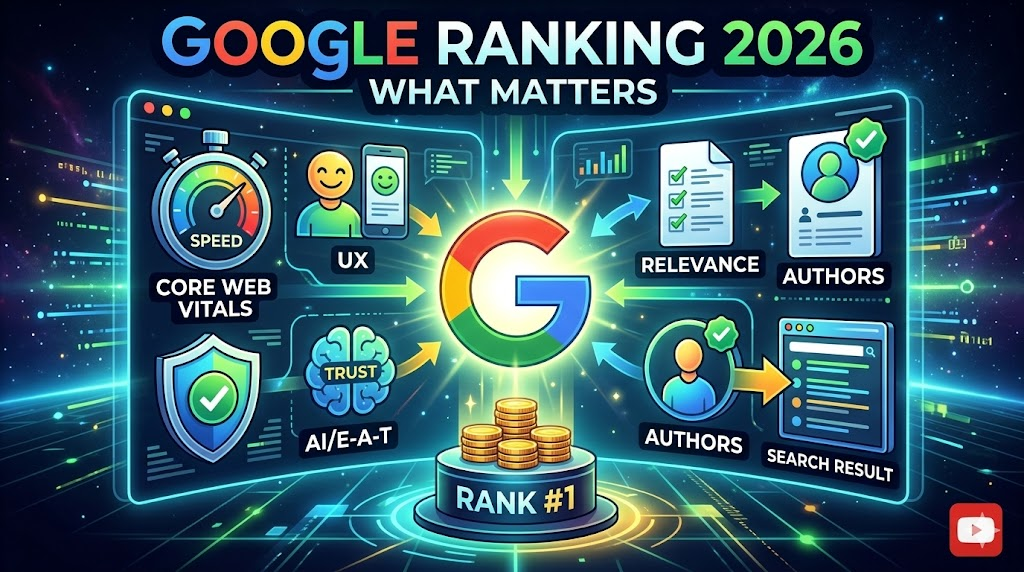
The landscape of search has undergone a tectonic shift. In 2026, ranking is no longer a game of keyword stuffing or mass backlink accumulation. Instead, visibility is defined by usefulness, trust, and clarity. With the full integration of the Search Generative Experience (SGE) and AI-driven quality evaluation, Google’s priority is delivering a definitive answer that satisfies a user’s need in a single visit.
If you are working with a digital marketing agency or managing your own brand’s SEO, understanding these ten core pillars is essential for survival and growth in the modern search era.

1. Content Experience (CX) Becomes the #1 Ranking Factor
In 2026, Google prioritizes the actual experience your content offers over the sheer volume of words published. It’s no longer just about providing information; it’s about providing a satisfying resolution. Google’s algorithms, heavily influenced by their Helpful Content System, evaluate:
- Expert Insights: Does the content provide firsthand experience or data that isn’t found elsewhere?
- Skimmability: Is the layout optimized with comparison tables, summaries, and clear headings?
- Outcome Satisfaction: Does the user feel their problem is solved without needing to go back to the search bar?
2. Granular Intent Satisfaction Depth
Search intent goes far beyond broad labels like “commercial” or “informational.” Modern search systems evaluate intent at a granular level. Google measures Intent Depth—how well your content aligns with the user’s specific context, decision stage, and expected outcome. Pages that target a keyword but fail to satisfy the real human need behind it will see declining visibility, regardless of how well optimized the page is technically.
3. E-E-A-T Is Now Measured More Strictly
Expertise, Experience, Authoritativeness, and Trustworthiness (E-E-A-T) are now measured through AI-verified profiles and digital footprints.
- Author Identity: Google’s AI cross-references authors across the web to verify their background and professional standing according to the Search Quality Rater Guidelines.
- Transparent Sourcing: Every claim must be supported by credible citations or real-world data. Anonymous content or vague claims struggle to compete in SGE results.
4. Page Experience & Core Web Vitals 2.0
While technical SEO remains essential, usability now outweighs speed alone. Google looks for frictionless browsing across all devices.
- INP (Interaction to Next Paint): As the newest Core Web Vitals metric, INP measures how fast your site responds to a user’s click or tap.
- LCP & CLS: Your site must load the main content quickly (Largest Contentful Paint) and remain visually stable without jumping elements (Cumulative Layout Shift).
- Accessibility: Your site must be distraction-free, lacking intrusive pop-ups, and easy to navigate.
5. Backlinks Still Matter, but the Rules Have Changed
Backlinks are now judged by trustworthiness and contextual alignment rather than sheer volume. Mass-produced, non-topical, or manipulative links are entirely ignored. What works in 2026 includes:
- Contextual Alignment: Mentions in niche-relevant publications.
- Entity Anchor Text: Links that use your brand name alongside authoritative terms, signaling a genuine editorial endorsement.
6. Topical Authority Beats Domain Authority
Domain Authority is largely a legacy metric. In 2026, Topical Authority wins. Google rewards sites that demonstrate clear specialization over those covering many unrelated subjects. Building content clusters around one core subject, interlinking related pages, and publishing deep, expert-led content signals reliability to search engines.
7. Entity SEO Becomes Essential
Google now pays closer attention to entities (people, brands, locations, concepts) rather than just relying on keyword matching.
- Brand Identity: Your brand must have a clear, consistent identity across the internet.
- Clarity: Google must clearly understand who you are and what you do to confidently feature you in Knowledge Panels and AI snapshots.
8. AEO (Answer Engine Optimization) Is Mandatory for SGE
To appear in AI-generated answers, you must practice Answer Engine Optimization. Your content must deliver a complete, self-contained response.
- Direct Answers: Lead with a concise, factual answer using natural language and question-based headings.
- Structured Data: Implement proper Schema Markup (like FAQ, HowTo, and Organization) to help AI extract meaning reliably.
9. Freshness & Content Updates Get Higher Weight
Simply updating the published date on your blog is no longer effective. Google’s AI compares historical versions of your content to detect genuine improvements. Freshness requires adding new data, reacting to new trends, and refining insights based on user feedback.
10. User Engagement Signals (Post-SGE Behavior)
Engagement is the ultimate validation. Google monitors how users interact with your site after clicking a result. Ranking improves when users stay longer, scroll, and visit multiple pages. Conversely, if a user bounces quickly and returns to Google for the exact same query, it signals that your page failed to satisfy their need.
Conclusion
SEO in 2026 is no longer about “gaming” the system. It is about understanding how Google thinks and how AI interprets content. If your website helps users quickly, delivers trustworthy content, and provides a seamless technical experience, you will win in both traditional search and the Search Generative Experience.
Also Read : 4 Essential Strategies for Navigating SEO in the AI Search Era