

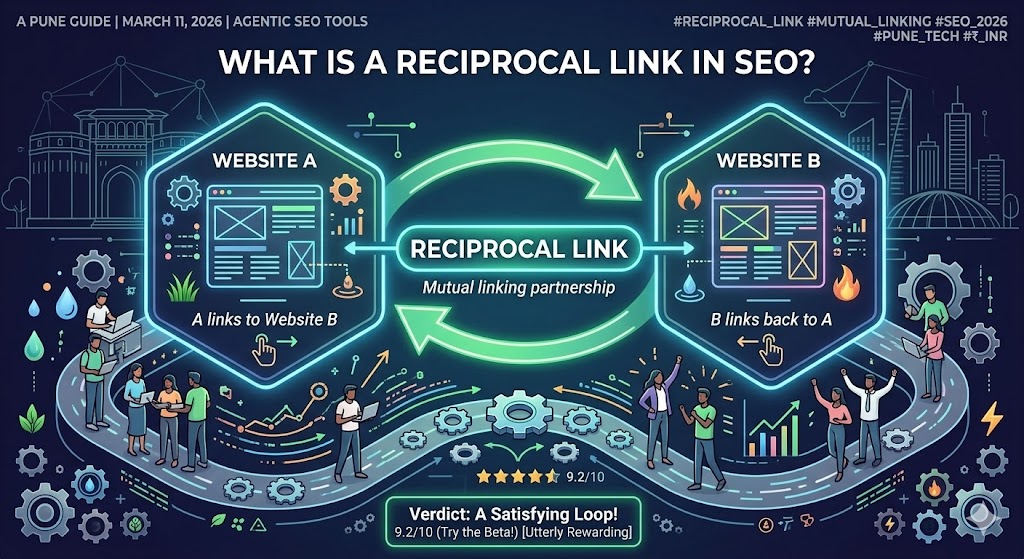
This blog explains reciprocal links in SEO in simple words—what they are, how they work, their pros and cons, and the safe ways to use them to improve visibility, traffic, and Google rankings.
There are billions of websites on the internet, and they are all competing to be noticed. For a website to appear higher in search engines such as Google, it must have more than just good content; it must also demonstrate strong trust signals. A link is one of the largest trust signals available. When one website links to another, it acts as a digital recommendation stating, “this site is useful and authoritative.”
Websites can receive links in various ways. Some occur naturally, while others are developed based on specific marketing strategies. One of the most historically popular methods is known as reciprocal linking. This occurs when two websites come to an agreement to link to each other, with the idea that both can share traffic and increase visibility.

Did you know? Studies show that around 73% of websites engage in some form of reciprocal linking. While it’s common, only those used naturally and sparingly bring real SEO benefits.
Reciprocal linking can initially sound like an easy and efficient means of growth, and in certain situations, it can be. However, search engines pay close attention to how these links are utilized. Reciprocal links are useful when done naturally. But when websites overuse them in a deliberate attempt to manipulate search engine algorithms, it can severely hurt their ranking rather than help.
This is why it is necessary to know what reciprocal links are, how they operate, and when they should be used in a modern SEO strategy.
Key Takeaways
- Reciprocal links mean two websites agree to link to each other for mutual benefit.
- When used naturally and sparingly, they can help drive referral traffic and visibility.
- Overusing link exchanges or linking to irrelevant sites violates Google’s Spam Policies and will harm your rankings.
- The safest strategy is to balance reciprocal links with a broader profile of high-quality, one-way backlinks.
Understanding the Basics of Links in SEO
Search engines use links as a primary trust signal. When numerous high-quality sites link to a specific page, it signals that the page is authoritative and provides value. This is why backlinks remain a foundational ranking factor.
There are three main types of links:
- Inbound links (Backlinks): Links that come from other external websites pointing to yours.
- Outbound links: Links you place on your website that point outward to other sites.
- Internal links: Links within your own website that connect one of your pages to another.
What is a Reciprocal Link in SEO?
A reciprocal link is a mutual link created between two websites. In a simple setup: Website A links to Website B, and in return, Website B links back to Website A.
In the early days of SEO, this was a highly common tactic. Webmasters exchanged links indiscriminately to inflate their backlink profiles and improve rankings within a short period. Over the years, however, search engine algorithms have become incredibly sophisticated. They now easily detect whether these link exchanges are genuine, relevant recommendations or manipulative schemes.
When applied organically, reciprocal links enable two complementary sites to share traffic and establish industry credibility. However, when done at scale purely for SEO purposes, they are classified as spam and can lead to manual penalties.
Why Do Websites Use Reciprocal Linking?
There are several legitimate reasons why websites still engage in reciprocal linking:
- Traffic Sharing: Visitors are referred to each other, creating mutual audience growth.
- Business Partnerships: Businesses, vendors, or bloggers might link to one another as a digital representation of a real-world partnership.
- Content Support: If two sites have complementary content, linking to each other provides readers with a broader, more helpful resource pool.
The Pros and Cons of Reciprocal Links
The Pros:
- Improved Visibility: Helps more users discover both websites.
- Audience Sharing: Exposes your brand to a relevant, tangential audience.
- Networking: Builds professional relationships with peers in the same industry.
The Cons:
- Looks Manipulative: Too many reciprocal links signal to Google that your backlink profile is artificially engineered.
- Irrelevant Exchanges: If two completely unrelated websites (e.g., a bakery and an auto repair shop) link to each other, it looks highly suspicious.
- Possible Penalties: Google may devalue the links entirely or actively reduce rankings for websites that rely heavily on artificial link exchange schemes.
How Search Engines View Reciprocal Links
Search engines understand that the internet is built on connections. It is entirely natural for a certain percentage of your links to be reciprocal. For example, if two tech bloggers frequently reference each other’s research, Google views this as a natural byproduct of a healthy digital ecosystem.
However, if a site engages in dozens of forced, low-quality link exchanges—often arranged via “link exchange” emails or forums—it raises an immediate red flag. SEO specialists advise keeping reciprocal links relevant, authentic, and minimal. Links that provide genuine value to the reader are always safe.
Best Practices for Reciprocal Links

If you are considering using reciprocal links in your strategy, follow these strict best practices:
- Ensure Strict Relevance: The website you link to must be highly relevant to your specific niche and subject matter.
- Prioritize Quality Over Quantity: One reciprocal link with a highly trusted industry partner is infinitely better than 50 weak links from random blogs.
- Avoid Link Farms: Never participate in private blog networks (PBNs) or chains of websites built solely to exchange links.
- Diversify Your Link Profile: Combine reciprocal links with other robust strategies like guest posting, digital PR, and creating high-quality, linkable assets.
- Check Authority: Only exchange links with trusted, authoritative sites that have clean backlink profiles themselves.
SEO Reciprocal Links vs. Natural Links
| Factor | Reciprocal Links | Natural Links (One-Way Backlinks) |
| Definition | A mutual agreement between two websites to link to each other. | Links given freely by other websites because they find your content valuable. |
| How They’re Created | Arranged through partnerships, outreach, or direct agreements. | Earned organically through high-quality content, research, or brand visibility. |
| SEO Value | Low to Moderate (Value can be discounted by search engines if deemed manipulative). | High (Considered the strongest trust signal by search engine algorithms). |
| Risk Level | High (If done at scale or with irrelevant sites). | Very Low (Completely safe and encouraged by search engines). |
What Does “Reciprocal Link” Mean in Moz?
Moz, a leading authority in SEO software, frequently discusses the concept of reciprocal links in the context of their proprietary metric, Domain Authority (DA). According to Moz’s research, while a small percentage of reciprocal linking is natural for any healthy website, relying on it as a primary link-building strategy does not effectively pass “link equity” (ranking power). Moz emphasizes that search engines actively discount the value of excessive 1-to-1 link exchanges, meaning they will not improve your Domain Authority and could instead trigger spam filters.
When Should You Use Reciprocal Linking?
You should only use reciprocal linking when it makes perfect sense for the human user. Ask yourself: Would I link to this website even if they weren’t linking back to me? Good use cases include:
- Linking to a supplier or vendor you actually use and trust.
- Partnering with a non-competing business in your local area (e.g., a wedding photographer linking to a local florist, and vice versa).
- Citing a fellow researcher or content creator whose work directly complements your own.
How SEO Discovery Can Help You with Link Building
Building a healthy, penalty-free backlink profile requires expertise and a careful strategy. At SEO Discovery, our team specializes in acquiring high-quality, natural backlinks through content marketing, digital PR, and ethical outreach. We can audit your current backlink profile to ensure any existing reciprocal links are helping rather than harming your site, and build a customized strategy to safely boost your search engine rankings.
Also Read : What are the types of SEO? You Need to Know for 2025