

When you search online—whether for health advice, financial tips, or travel ideas—you expect information that is reliable, accurate, and written by someone who actually knows what they are talking about. With millions of websites competing for attention, how does Google decide which pages deserve to appear first?
That is where E-E-A-T comes in.
Did you know? Websites that clearly display author credentials, cite reputable sources, and maintain updated content see an average 22% higher ranking on Google compared to sites with weak E-E-A-T signals.
It is no longer enough to just select the correct keywords or build a flashy website design. Today, SEO is about demonstrating that your content is legitimate, factual, and produced by a credible source. Because Google’s ultimate goal is to deliver safe and useful information to its users, websites that project strong E-E-A-T signals have a significantly higher chance of dominating the search results.+1
Whether you are a business owner, blogger, or digital marketer, understanding E-E-A-T is critical to your content strategy. Here is everything you need to know about this framework, why it matters, and how you can optimize your site for it.
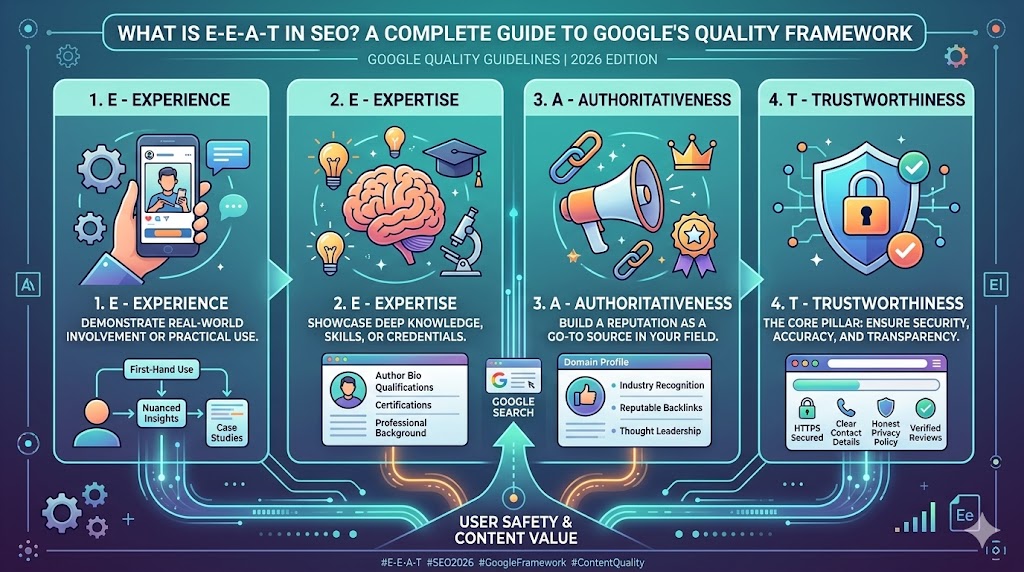
Understanding the 4 Pillars of E-E-A-T
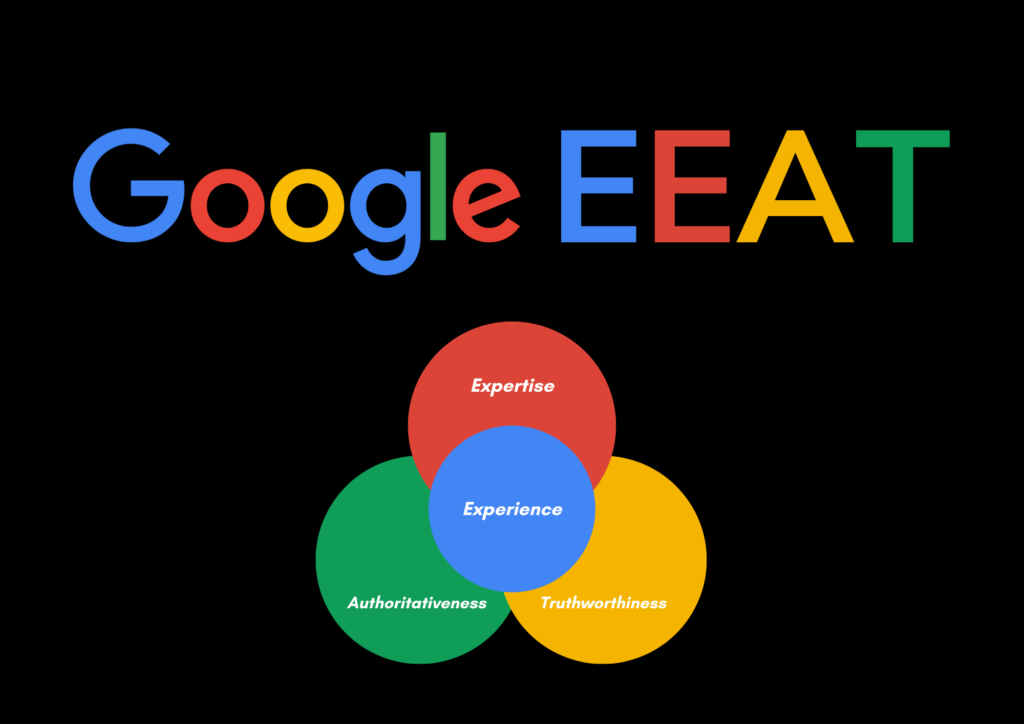
E-E-A-T stands for Experience, Expertise, Authoritativeness, and Trustworthiness. In late 2022, Google updated its Search Quality Evaluator Guidelines to add an extra “E” (Experience) to its original E-A-T framework. Here is what each component means for your website:
| E-E-A-T Pillar | What It Means | How to Demonstrate It |
| Experience | First-hand, practical knowledge of the topic. | Share personal stories, original photographs, case studies, or product trial results. |
| Expertise | Formal knowledge, qualifications, or deep skill in a specific field. | Display author credentials, licenses, or professional titles alongside the content. |
| Authoritativeness | Your reputation as a go-to source within your industry. | Earn high-quality backlinks, industry mentions, and positive external reviews. |
| Trustworthiness | The overall safety, accuracy, and transparency of your website. | Use HTTPS encryption, provide clear contact info, and cite reputable sources. |
Note: According to Google, Trustworthiness is the most critical component of the entire framework. Experience, Expertise, and Authoritativeness are all signals that help build that core trust.+1
How Does E-E-A-T Impact SEO?
While E-E-A-T is not a direct, quantifiable ranking metric (like page speed), it is the conceptual framework Google uses to train its algorithms. Aligning with these guidelines impacts your SEO in several powerful ways:
- Better Rankings for Quality Content: Google’s helpful content system actively rewards sites that prove their expertise and authority, pushing them higher in the search engine results pages (SERPs).
- Improved User Engagement: When users see clear credentials and credible writing, they spend more time on the page. Lower bounce rates and longer session durations send positive engagement signals to Google.
- Increased Link-Building Potential: High-quality, factual content is inherently more “link-worthy.” Other websites are far more likely to reference your work if you are a recognized authority.
- Protection Against Algorithm Penalties: Google frequently demotes websites that spread misinformation or provide poor user experiences. Strong E-E-A-T protects your site during major core algorithm updates.
E-E-A-T and YMYL: Why It Matters
You cannot discuss E-E-A-T without mentioning YMYL—which stands for “Your Money or Your Life.” YMYL refers to topics that could directly impact a person’s health, financial stability, safety, or well-being. Google treats YMYL pages with extreme scrutiny. If you are writing a blog post about your favorite TV show, the E-E-A-T requirements are fairly low. However, if you are publishing content about medical dosages, investment strategies, or legal rights, the standards are incredibly high.
For YMYL content, misinformation can cause real-world harm. Therefore, demonstrating flawless Expertise and Trustworthiness is absolutely non-negotiable if you want to rank.
5 Strategies to Improve E-E-A-T for SEO
Improving your website’s credibility does not happen overnight. It requires a sustained commitment to quality. Here are five actionable strategies you can implement right now:
- Showcase Author Experience and Expertise: Do not publish under generic “Admin” accounts. Add detailed author bios that include real-world experience, professional certifications, and links to the author’s social media or LinkedIn profiles.
- Create Authoritative Content: Move beyond surface-level articles. Provide in-depth, original research, and always reference reputable, primary sources to back up your claims.
- Build Trust with Users: Ensure your website uses HTTPS. Make your privacy policies, terms of service, and customer support contact information highly visible and easy to access.
- Strengthen Online Authority: Actively work on your digital PR. Obtain backlinks from trusted websites in your niche, gain mentions in reputable publications, and encourage verified customer reviews.+1
- Regularly Update Content: Outdated information destroys trust. Keep your content current and accurate, fix broken links, and periodically reassess your older posts to ensure they still meet today’s standards.
E-E-A-T in Different Industries
Different sectors have varying requirements for demonstrating credibility. Here is how E-E-A-T applies across four major YMYL industries:
| Industry | Key E-E-A-T Requirement | Actionable Strategy |
| Health & Wellness | Qualified Authors & Medical Citations | Use licensed healthcare professionals to write or review content, and cite peer-reviewed medical journals. |
| Finance | Transparency & Verifiable Models | Disclose any conflicts of interest or sponsorships, and provide clear explanations of financial calculations. |
| Legal | Jurisdiction Accuracy & Precedents | Ensure content is reviewed by licensed attorneys and cites specific, up-to-date laws or case statutes. |
| E-Commerce | Secure Transactions & Clear Policies | Provide detailed product specifications, transparent pricing (including shipping), and display trusted security badges. |
Common Misconceptions About E-E-A-T
To ensure your SEO strategy is on the right track, it is important to clear up a few common myths:
- Myth: E-E-A-T is a direct ranking factor with a specific “score.” Fact: It is a framework used to assess quality, not a metric Google assigns a numerical value to.
- Myth: You can fake E-E-A-T with good web design. Fact: A beautiful website does not compensate for thin, inaccurate, or scraped content.
- Myth: More backlinks equal more authority. Fact: A single high-quality backlink from a trusted industry leader heavily outweighs dozens of low-quality, spammy links.
Boost Your E-E-A-T and Rankings with SEO Discovery
Implementing E-E-A-T principles can feel overwhelming when you are already managing daily business operations, content creation, and user engagement. That is where SEO Discovery steps in.
We specialize in helping businesses, bloggers, and e-commerce stores strengthen their E-E-A-T SEO signals while dramatically improving search performance. Our services go beyond basic keyword optimization to ensure your content meets Google’s highest quality standards—from crafting expert author bios and building trust signals to executing high-authority backlink campaigns.
FAQs About E-E-A-T in SEO
What is the difference between E-A-T and E-E-A-T? In December 2022, Google added an extra “E” for “Experience” to the original E-A-T acronym. This update highlights the value of first-hand, practical experience in content creation, ensuring users get advice from people who have actually used a product or lived through a situation.
Does E-E-A-T apply to non-YMYL websites? Yes. While the standards are strictest for Your Money or Your Life (YMYL) topics, Google still prioritizes helpful, reliable, and people-first content across all niches. Strong E-E-A-T signals will benefit any website looking to build audience trust and improve rankings.
How can I conduct a quick E-E-A-T audit on my site? Start by reviewing your author bios to ensure credentials are clear. Check your top-performing pages for accuracy and proper citations. Finally, verify your technical trust signals, ensuring your SSL certificate (HTTPS) is active and your contact/privacy pages are easily accessible from the main menu
Also Read : 4 Essential Strategies for Navigating SEO in the AI Search Era